For independent businesses across Maryland, the transition into the third quarter represents more than just a calendar flip—it marks a vital operational juncture. By mid-summer, initial annual forecasts have collided with market realities, supply chain dynamics have normalized, and seasonal consumer behavior has settled into a predictable rhythm. It is during this high-heat season that one fundamental financial health metric rises above all others: the cash flow cycle.
A business can boast robust sales, a packed order pipeline, and expanding market share, yet still find itself facing severe operational strain if its liquid capital is trapped in an inefficient lifecycle. According to comprehensive data tracking macro-level economic realities, more than 80% of small business failures are directly linked to poor cash flow management, despite many of those organizations maintaining theoretical balance-sheet profitability.
Optimizing liquidity demands a deliberate transition from baseline cash monitoring to proactive treasury management. This detailed blueprint breaks down the mechanics of the corporate cash lifecycle and explores the specialized banking solutions available to accelerate receivables, safely manage disbursements, and maximize every dollar of working capital.
1. Anatomy of the Cash Flow Lifecycle
To effectively manage liquidity, business owners must first understand the structural timeline that governs cash movement within a commercial enterprise. At the core of this timeline sits the Cash Conversion Cycle (CCC), a fundamental financial metric that measures the duration (expressed in days) it takes a company to convert its initial investments in inventory and resources back into cash through sales.
The cycle relies on three distinct operational variables:
- Days Inventory Outstanding (DIO): The average number of days your capital is tied up in raw materials, work-in-progress components, or finished goods before a sale is made.
- Days Sales Outstanding (DSO): The average timeframe required to collect cash from customers after a credit sale has been finalized and invoiced.
- Days Payable Outstanding (DPO): The average window of time your business takes to settle its obligations with vendors, suppliers, and trade partners.
Mathematically, the relationship is expressed as:
Cash Conversion Cycle (CCC) = DIO + DSO – DPO
An extended, or positive CCC, means cash is locked up within operations, limiting your flexibility and forcing your business to rely heavily on working capital loans, lines of credit, or cash reserves to cover routine overhead. Conversely, a compressed or negative CCC indicates a highly efficient operational engine that generates liquidity quickly, allowing you to internally fund ongoing operations and strategic growth.
Identifying Structural Disconnects
For small and mid-sized businesses, cash flow imbalances rarely stem from a single catastrophic event. Instead, they occur due to small, persistent inefficiencies within daily workflows.
Common operational pitfalls include:
- The Revenue-to-Collection Gap: Fulfilling a substantial corporate or municipal order requires immediate investments in labor, materials, and transportation. If customer payment terms are standard Net-30 or Net-60, your business must independently carry those operational costs for up to two months, exposing you to significant liquidity risk.
- Asymmetrical Credit Dynamics: Small businesses often have to absorb rigid, immediate payment terms from large upstream suppliers while extending loose, generous credit windows to downstream customers to keep sales moving.
- Administrative Drag: Traditional, manual paper-based invoicing, processing physical checks, and physically driving deposits to a bank branch adds days of unnecessary delay to your DSO.
2. Accelerating Receivables: Modernizing Inflows
The quickest way to compress your Cash Conversion Cycle is to optimize your incoming revenue workflows. Every day trimmed from your DSO directly increases your liquid cash reserves, reduces your reliance on short-term debt, and provides an immediate financial cushion.
Remote Deposit Capture (RDC)
For businesses that still receive physical checks from corporate accounts, commercial clients, or trade partners, the traditional manual deposit workflow is a significant source of operational friction. Collecting checks, keeping them in an office safe, manually filling out deposit slips, and dedicating staff time to visit a local branch can delay fund availability by 48 to 72 hours.
Implementing Remote Deposit Capture (RDC) removes this friction entirely by placing a secure, digital scanning terminal right on your office desk or storefront counter.
[Manual Workflow] Receive Check ──> Sort & Store ──> Drive to Bank ──> Manual Processing (2-3 Days Delay)
[Modern Workflow] Receive Check ──> Scan via RDC ──> Instant Digital Submission ──> Rapid Processing
By digitizing incoming checks, your business secures several strategic operational advantages:
- Bank on Your Schedule, 24/7: Optimize your business cash flow by making deposits from your office right into your Bank of Glen Burnie checking account any time of day.
- Minimized Operational Risk: Eliminate the need for employees to transport physical checks or cash to reduce the risk of loss, internal errors, or transit accidents.
- Enhanced Multi-Location Management: Enterprises operating across multiple locations or regional offices can centralize their check processing, giving leadership instant oversight of total daily inflows.
ACH Collection Networks
Transitioning your customer billing away from physical checks and onto Automated Clearing House (ACH) networks using our ACH Manager product shifts your collection workflow from a reactive posture to a proactive one. Instead of waiting for a client to manually cut a check or initiate a transfer, your business can directly initiate authorized collections for recurring bills, retainer fees, or installment invoices.
Utilizing automated clearing house (ACH) collections provides predictable, exact settlement dates, allowing your accounting team to plan outbound vendor payments with high precision.
3. Optimizing Disbursements: Controlling Outflows
While accelerating incoming cash is vital, managing outbound payments is equally critical to building a stable working capital foundation. Proper disbursement management does not mean delaying vendor payments or avoiding obligations; rather, it means strategically timing outflows to keep cash in your accounts for as long as possible while ensuring ironclad payment security.
Integrated ACH Payroll and Vendor Payments
Shifting from paper checks to automated electronic payments for your payroll and vendor management is a foundational cash management best practice. Writing and mailing physical checks leaves your cash outflows unpredictable, as you cannot control exactly when a vendor or employee will choose to cash them. This forces you to hold artificial, uninvested safety balances in your checking accounts to cover outstanding checks.
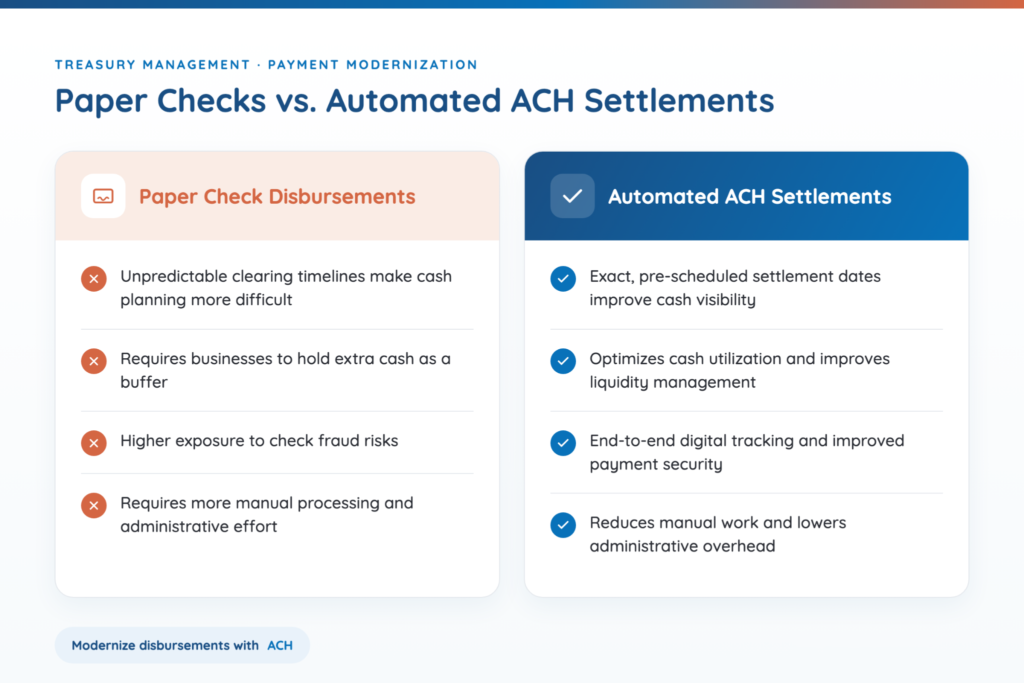
Automating your payments through electronic networks transforms your outbound cash flows into a highly predictable schedule. Your financial managers can pinpoint the exact date and time funds leave your operating accounts. This precision allows you to maximize your internal yield, take full advantage of early-payment vendor discounts (such as 2/10 Net 30 terms), and streamline your bookkeeping with complete digital audit trails.
Online Bill Pay Platforms
Modern commercial bill-paying platforms like BofGB’s CheckFree Business Bill Pay are integrated into business online banking and reduce administrative friction by replacing manual invoicing work with a web-based dashboard.
Through these secure hubs, accounting teams can:
- Set up automated, recurring rule schedules for fixed utilities, commercial lease payments, and financing obligations.
- Build custom internal approval hierarchies, ensuring that large outbound expenses require digital sign-offs from designated managers before execution.
- Export clean payment histories directly into mainstream accounting programs, eliminating manual data entry mistakes and saving valuable staff hours during mid-year reconciliation.
4. Mitigating Fraud and Securing Commercial Assets
As financial workflows go digital, commercial enterprises become prime targets for sophisticated cybercriminals and payment fraudsters. A single unauthorized withdrawal, forged check, or intercepted wire transfer can disrupt an organization’s cash flow for weeks, tying up vital liquid assets during crucial investigations. Safeguarding your capital requires multi-layered, automated treasury security solutions.
Protecting Your Accounts with Positive Pay
Fraud remains an ongoing threat to businesses of all sizes. Criminals can intercept legitimate mail, use chemical washing techniques to alter payees and amounts, or create entirely counterfeit checks using stolen corporate account details. Fraudulent electronic transactions also pose a risk to businesses.
Check Positive Pay serves as an automated digital gatekeeper for your checking accounts. Under this system, issued checks are matched against those presented for payment. Customers can manually enter individual check file information or upload a check issue file detailing the check numbers, exact amounts, and designated payees into our secure online banking portal.
When a check is presented to The Bank of Glen Burnie for payment, the system automatically cross-references its details against your pre-approved list. If any variable—such as an altered dollar amount or an unfamiliar payee—does not match perfectly, the system pauses the transaction. It then flags the check as an exception and sends an immediate alert, giving you the power to explicitly approve or reject the payment before any funds leave your account.
Just as Check Positive Pay secures your physical paper transactions, ACH Positive Pay protects your accounts from unauthorized digital withdrawals. Without these protections, any entity that obtains your corporate routing and account numbers can attempt to pull funds directly out via electronic debit networks.
Within Positive Pay, business owners define ACH authorization rules that determine the types of ACH transactions that will be allowed to process or post to your account. Businesses can establish an approved vendor list, block vendors, and set monitoring criteria like maximum dollar limits, frequency, and date ranges. Any inbound debit request that doesn’t meet the established rules will be blocked and held for manual review. This simple step ensures your working cash cannot be drawn down without explicit corporate authorization.
5. Liquidity Strategies: Balancing Return and Protection
Effective cash management requires balancing daily liquidity with safe wealth preservation. Holding all your liquid capital in a non-interest-bearing operating account leaves your money exposed to inflation and can cap your federal deposit insurance protections. True financial stability means maximizing your return on excess cash while maintaining instant access to funds for unexpected opportunities or emergencies.
Maximizing Yield via Business Savings and Certificates of Deposit
Cash balances that sit idle for 30, 60, or 90 days ahead of major seasonal inventory buys, quarterly tax obligations, or long-term capital investments should be actively generating yield. By dividing your liquid capital into tiers based on when you will need it, you can direct excess funds into specialized interest-bearing business savings accounts or short-term Certificates of Deposit (CDs). This approach ensures your money works just as hard as your team, boosting your bottom line with predictable, risk-free returns.
Solving the FDIC Insurance Ceiling with ICS® and CDARS®
One of the biggest hurdles facing expanding enterprises is navigating the standard $250,000 Federal Deposit Insurance Corporation (FDIC) coverage cap per institution. When a business holds millions of dollars in operational cash, excess funds beyond that threshold are exposed to bank counterparty risk. Corporate treasurers often open accounts at multiple banks to protect their cash, creating fragmented accounting, scattered tracking, and a mess of monthly statements.
Modern treasury solutions like ICS® (IntraFi Cash Service) and CDARS® (Certificate of Deposit Account Registry Service) that are available to our customers, solve this problem by providing access to multi-million-dollar FDIC protection through a single banking relationship with The Bank of Glen Burnie.
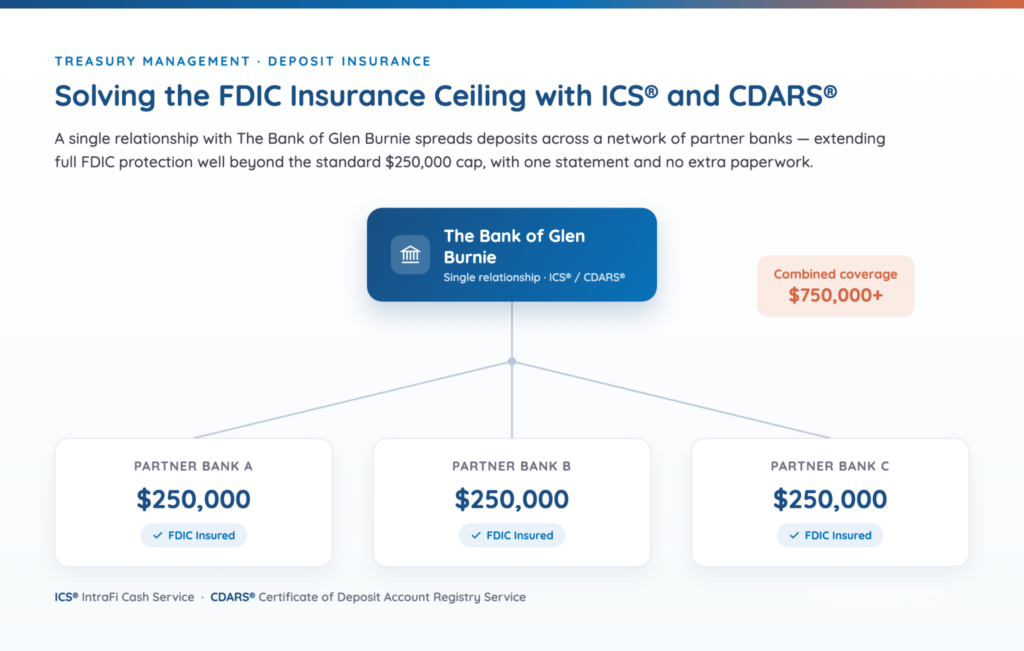
When your business deposits funds at The Bank of Glen Burnie through ICS® or CDARS®, we automatically distribute those assets in chunks under $250,000 across a massive national network of well-capitalized, FDIC-insured partner banks.
This automated distribution yields major structural benefits for your business:
- Full Insurance Coverage: Millions of dollars in capital become backed by full federal deposit insurance protection.
- Unified Accounting: Your team avoids the headache of monitoring dozens of different bank accounts. You manage everything through a single online login and receive one clear, consolidated monthly statement.
- Local Capital Deployment: Even though your funds are spread out to maintain insurance compliance, the reciprocal relationship ensures your local bank retains equivalent deposit credit. This allows them to re-invest that capital back into loans for your neighborhood’s economy.
6. Developing a Dynamic Cash Flow Forecast
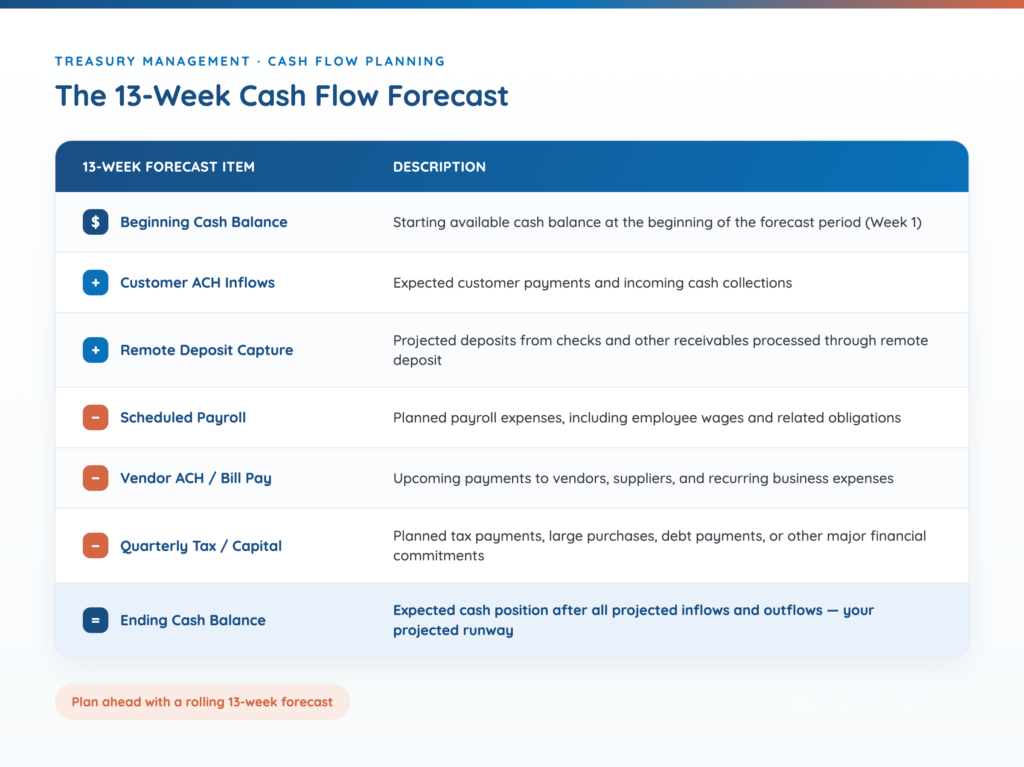
Implementing cash management tools is highly effective, but their true value is unlocked when paired with an ongoing, accurate forecasting model. A cash flow forecast acts as an early warning radar for your business, helping you spot upcoming cash shortages well before they threaten daily operations.
Step-by-Step Forecasting
To build a functional, 13-week rolling cash forecast, your internal accounting team should follow this structured process:
- Establish Your Baseline Inflows: Analyze your historic accounts receivable records to determine your actual collection timelines. Do not assume invoices are paid on day 30 just because your terms say so; look at reality. If your clients historically take 42 days to pay, build your cash inflow expectations around that 42-day average.
- Map Out Fixed and Variable Outflows: List all non-negotiable fixed expenses—such as lease payments, payroll liabilities, utilities, and insurance premiums—alongside variable costs like raw materials, seasonal marketing campaigns, and travel expenses.
- Account for Seasonal Cycles and Taxes: Build in large, infrequent cash drains, such as quarterly estimated tax distributions, annual corporate insurance renewals, or seasonal inventory surges ahead of the autumn rush.
- Stress-Test Your Model: Run scenarios where your largest client delays their payment by 30 days, or supply chain disruptions force you to pay 15% more upfront for raw goods. Seeing how these events impact your cash position helps you figure out exactly how much of a liquid cushion you need to maintain.
Conclusion: Partnering with The Bank of Glen Burnie, Your Local Community Bank
Optimizing your corporate cash flow is an ongoing process that requires combining smart internal strategy with the right financial technology. In today’s economic climate, small and mid-sized businesses cannot afford to let their working capital get bogged down by slow, manual systems or exposed to payment fraud.
While massive, out-of-state financial institutions offer standard cash management software, they often treat local enterprises as simple account numbers on a spreadsheet. True operational efficiency is built by partnering with a dedicated local community bank like The Bank of Glen Burnie that combines top-tier commercial banking tools with responsive, personalized support.
As a local bank, we understand the unique economic landscape of our region. We provide direct access to dedicated cash management specialists who can audit your current collection systems, implement automated safeguards like Positive Pay, and scale your accounts smoothly as your company grows. By moving away from outdated, manual workflows and adopting a modern cash management framework, you protect your bottom line, free up your staff, and unlock the liquid capital your business needs to grow.
Sources Cited
- Federal Reserve Financial Services. The Strategy for Improving the U.S. Payment System. A detailed analysis highlighting how adopting ACH and digital workflows reduces corporate transaction overhead and speeds up national collection timelines.
- Association for Financial Professionals (AFP). Payments Fraud and Control Survey Report. Industry data demonstrating the vital role automated tools like Positive Pay and ACH filtering play in blocking check and digital payment fraud.
- Federal Deposit Insurance Corporation (FDIC). Deposit Insurance Coverage Guidelines. Official regulatory framework establishing institutional protection thresholds and validating reciprocal deposit placement networks like ICS and CDARS.
- U.S. Small Business Administration (SBA). Office of Economic Research Capital Studies. Research highlighting the direct link between working capital management and long-term survival rates for independent companies.
Transform Your Treasury Management Today
Don’t let inefficient cash cycles slow down your business growth. Contact The Bank of Glen Burnie to set up a comprehensive treasury management review with our local commercial banking specialists. Let’s work together to customize an electronic collection, payment, and asset protection strategy designed to keep your business moving forward.
👉 Connect With Our Local Business Specialists: The Bank of Glen Burnie – Contact Us